AI isn't your biggest brand risk. Mediocre taste is.
Your biggest risk isn't AI. It's mediocre taste. Not the absence of design skill. The absence of conviction about what makes your brand worth noticing. Taste isn't mystical. It's learnable. It's systematic. And it's your responsibility to build it into your organisation.
The content glut we’re not talking about enough
You've probably been told AI will transform your marketing by making content creation faster and cheaper. And it will. The problem is that it's doing the same for every brand in your category. The result isn't a flood of bad design. It's something more dangerous: a feed full of smart, well-funded companies that all look vaguely the same.
The real risk to your brand in an AI-heavy world isn't that your team will produce ugly work. It's that they'll produce perfectly competent, totally forgettable work. Your biggest moat now isn't access to AI. It's taste.
Consider what's actually happening at scale: research analysing 4 million artworks across 50,000 AI users found that average content novelty declines over time among adopters. Not increases but declines. This isn't because AI got worse. It's because AI algorithms favour dominant trends and neglect avant-garde approaches.
You're investing in AI to accelerate your marketing. What you're actually doing is accelerating average.
This means AI doesn't just give you more content; it gives you the ability to flood the world with high-quality sameness. Your visuals could be swapped with a competitor's on your next campaign, and nobody would notice. Not because your design team isn't skilled. But because the tools they're using (and the incentives surrounding them) have made mediocrity the default.
Why your category feels ‘samesies’ (it's deliberate)
Walk through any SaaS category, any designer's portfolio site, any brand's Instagram feed, and you'll see the same visual language repeating: on-trend gradients, abstract blobs, friendly characters, and layouts that could belong anywhere. Scholars describe this as "platform realism". These include images that look polished and plausible but flatten everything into the same visual soupiness.
This isn't happening by accident. It's systemic.
It's not laziness. It's your metrics.
Your design team gets rewarded for safe, because safe is measurable. Social posts "perform" (clicks, impressions) even when emotionally anonymous. Your KPIs track engagement, not distinctiveness. Your metrics don't capture whether your brand is recognisable, only whether it's visible right now.
Research from McKinsey on design leadership metrics shows that teams often inherit business KPIs that favour engagement and conversion over distinctiveness. Which means safe, proven approaches get systematically rewarded over anything risky or specific.
Your team isn't choosing mediocrity. Your systems are incentivising it.
The SaaS market is a perfect case study. MailModo research found that SaaS buyers check 5-10 competing tools before deciding, and most look identical. Why? Because design is outsourced to templates and AI tools that converge toward "proven" patterns. Every vendor using the same AI tools with the same training data trends toward the same output. When Booking.com needed to scale design across 200+ designers without losing brand coherence, they didn't solve it by adding more people. They solved it by establishing clear taste governance. Decisions about which patterns to follow and which to deliberately break.
Without that governance, the result is visual noise. With it, you get distinctiveness at scale.
The Pattern Recognition Blindness
The uncomfortable part is that most brands in a category are not perceived as differentiated, yet customers still buy them. 76% of respondents perceive at least one brand in their category as unique. But only 19% perceive a specific market leader as unique.
This paradox means something important: you don't need revolution. You need to be recognisable. But mediocre brand identity is invisible.
Which makes us ask: how do you recognise a brand when all brands look the same?
How deliberate ugliness became a cultural moment
In June 2024, Charli XCX released an album cover that breaks every rule in the design textbook. By every traditional measure, it should have died in a client meeting.
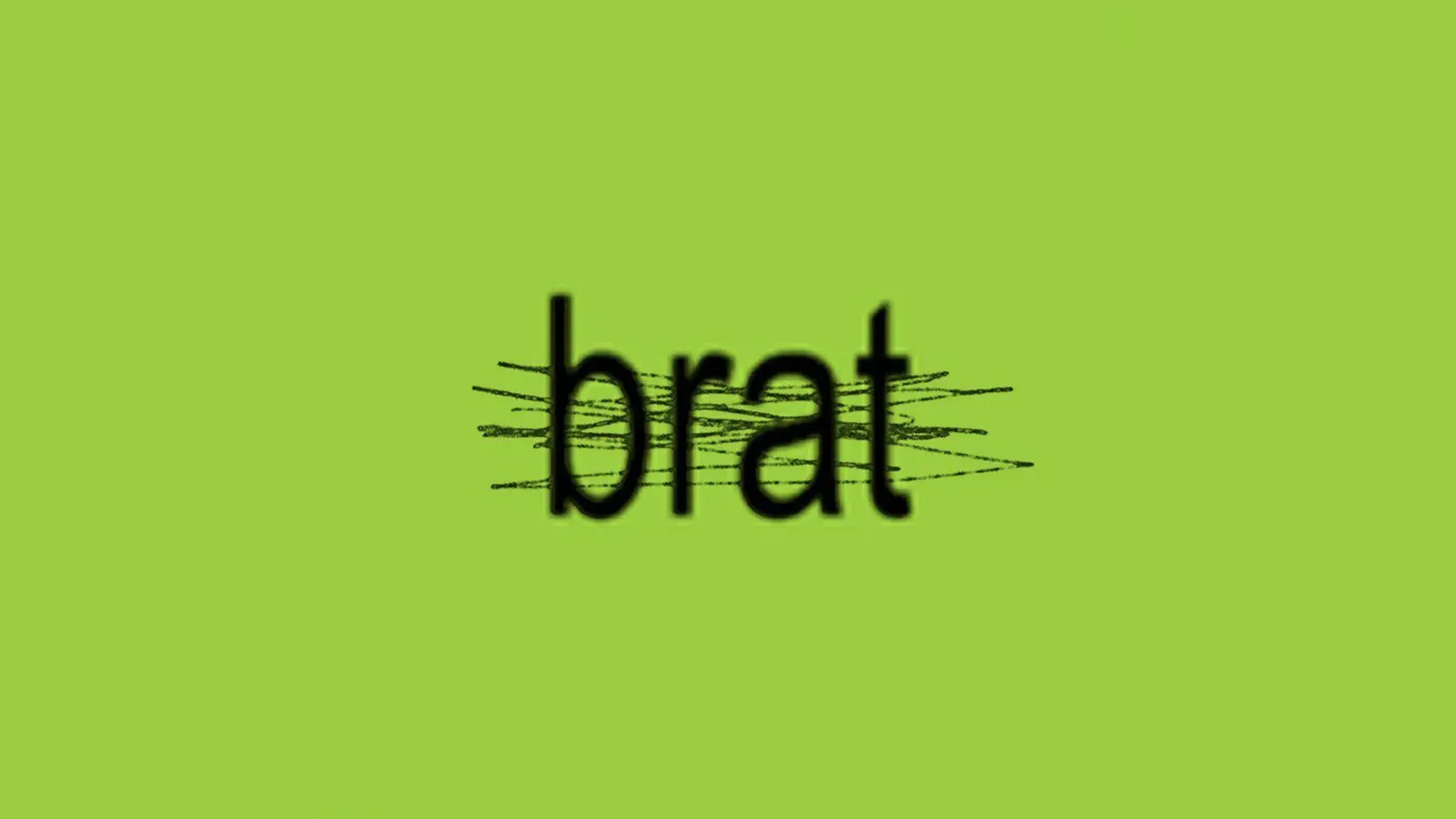
The visual itself is a lurid lime green square (Pantone 3507C) with the word "brat" in a distorted, pixelated Arial font. No photography. No gloss. No polish. Described as "four blurry letters centred in a puke-green square."
Run this through a design critique:
- Contrast & Legibility: Arial on neon green creates eye strain. Pixelation makes it harder to read. It violates accessibility standards.
- Colour Psychology: Green is oversaturated in design and fashion. Chartreuse specifically is avoided in corporate branding because of how aggressively it reads. It creates cognitive dissonance (what should look professional looks cheap).
- Professional Polish: No visual hierarchy. No breathing room. It looks like it was made in PowerPoint or a free online design tool.
- A/B Testing Prediction: If tested against alternatives, it would lose every metric. User testing would flag it as "unprofessional." Quantitative design validation would reject it.
By every design principle, every metric, every stakeholder review process, this cover should have failed.
And yet.
Understanding cultural timing
What the metrics missed was that Charli XCX didn't just make a risky design choice. She made the right risky choice for a specific moment in culture.
The design team (Brent David Freaney and Special Offer, Inc., working under art direction from Imogene Strauss) spent five months testing roughly 500 different shades of green before landing on the final one. Not testing whether to be green. Testing which shade of green would feel most aggressively off-trend. When everyone told her no (her manager, her creative director, her friends, Atlantic Records), she held the line. "Everyone was against it," Charli said later. "But I was adamant."
Charli understood something about the moment.
By June 2024, the "Clean Girl" aesthetic had dominated social media for three years. Glass skin, minimalism, quiet luxury, curated perfection. Gen Z was exhausted. There was also economic anxiety (recession concerns, cost-of-living crisis) making aspirational consumption (especially quiet luxury) feel tone-deaf. What emerged instead was an appetite for authenticity. For mess. For something that felt real.
Charli's positioning: "I wanted to go with an offensive off-trend shade of green to trigger the idea of something being wrong. I'd like for us to question our expectations of pop culture—why are some things considered good and acceptable, and some things deemed bad?"
She understood her audience intimately. She understood the pop landscape (airbrushed, overproduced, exhausted). She understood that moment's cultural appetite for something raw, hedonistic, and self-aware. And she had the conviction to bet on it.
The album content matched the visual. Songs about vulnerability (motherhood fears, body image) mixed with party energy. Electronic, club-focused production with human rawness. Party anthem plus emotional confession in the same track.
The visual wasn't just different; it felt like a cultural mood.
The business outcomes
That single green JPEG became a graphic design event. The colour dominated social feeds, inspired memes, became a fashion trend, triggered political discourse ("Kamala IS brat"), and launched a cultural moment that lasted months. Over 21 million unique videos were posted to the Brat Wall in Greenpoint, Brooklyn. The #bratsummer hashtag spawned 2.6+ million Instagram posts by July 2024.
The Kamala Harris moment alone generated an estimated $100+ million in earned media value. On July 21, 2024, Charli tweeted "kamala IS brat," which received 53.9 million views in four hours. The Harris campaign rebranded, adding a brat-green header to their profile. It was the first time a pop culture visual aesthetic crossed directly into political branding.
One taste-driven decision outperformed six months of AI-generated content.
It's not about execution. It's about judgement.
Our belief is that (obviously) AI could generate this image. Midjourney could create a green square. Nano Banana could add the text. What AI can't do is decide to make it.
Figma CEO Dylan Field pointed to Brat on a recent podcast as exactly the kind of work current AI cannot originate. "It only makes sense if you understand Charli's persona, the pop landscape, the appetite for something raw and 'trashy,' and the timing." AI optimises for what has worked in the past. Taste is choosing what hasn't been proven safe yet.
This isn't about design skill. It's about judgement. It’s about the ability to recognise cultural saturation, understand audience context deeply, and bet on something uncomfortable before the data confirms it's right.
Nielsen Norman Group research on AI design tools notes that their pattern-matching tendency drives them toward the most common solutions, not the most contextually meaningful ones. The output often feels "good from afar, but far from good." Amplify Partners research on creative AI tools points out that AI lacks the "sustained act of making". This includes the iterative, intentional process that human creators bring to work. AI regenerates, and humans refine. AI matches patterns in data and humans understand the contradictions in culture.
Consider the failures. Heineken's 2018 "Lighter Is Better" campaign tried to break conventions but missed cultural sensitivity entirely, creating backlash around racial undertones. American Eagle's 2025 campaign generated 3,000+ negative news articles because the team misread their Gen Z audience. Balenciaga's 2023 child safety crisis shows what happens when creative choices break conventions without understanding cultural impact.
All three tried to be different. None had the contextual intelligence to be different right.
AI can remix what's proven. Taste makes what's next.
That's the distinction. AI can remix what culture has already rewarded. Taste is how you make the thing culture hasn't caught up to yet. That requires standing outside the data. Something algorithms can't do.
What we actually mean by taste
"Taste" gets thrown around like it's mystical. Something you either have or don't. But it's not. It's systematic.
Taste = Pattern Recognition + Context + Courage
Seeing what your category is already drowning in
You can't have taste without landscape knowledge. If you don't know what your category looks like visually, you can't intentionally break it. So the first step is brutal honesty: what visual language is your category already saturated with?
Ask your team to list ten competitors' visual systems. Document the colour palettes. The typography. The layout patterns. The character styles. You'll find clustering immediately. Gradients trending up. Minimalism dominant. Blob illustrations everywhere.
This is the water you're swimming in. The default your audience has become numb to.
Forbes research on AI homogenisation shows that algorithms favour dominant trends. They learn from what's popular, not what's novel. This creates a self-reinforcing cycle: trends cluster, convergence accelerates, and novelty declines. Your competitors are using the same AI tools, landing on the same outputs, reinforcing the same visual language.
Pattern recognition means seeing this and saying: "That's the trap. We're not going there."
Understanding your Audience, moment, and reality
Context is where most teams stumble. They have pattern recognition. They can see what's been done. But they miss why it was done and when it stops working.
Charli understood her audience wasn't just demographic data. It was lived knowledge: Gen Z's fatigue with perfectionism, their appetite for honesty over curation, and their specific relationship to pop culture. She understood the moment: recession anxiety, exhaustion with aspirational consumption, and a cultural hunger for something that felt real. And she understood her own position: perpetual outsider, never the "role model pop girl", always the one who doesn't fit.
The design choice only made sense in that context. Brat green wouldn't work for a luxury brand or a B2B SaaS platform. It worked for Charli because it was her. Her persona, her audience, her moment.
Context includes who your audience is (not just demographics but also their values, pain points, and what they're tired of). What cultural moment you're in (not just the season, but the mood of the moment). What your product actually does (Patagonia can be anti-consumer because their business model is built on that contradiction; a fast-fashion brand can't).
If someone can't tell you why a design choice is right for your specific audience in this moment, it's not taste. It's trend-following.
Be willing to choose wrong on purpose
This is the hardest part. It's saying to your team, your CEO, and any other stakeholders, "This feels right, even though the data doesn't confirm it yet. I'm betting on it."
That's taste.
Patagonia's "Don't Buy This Jacket" campaign directly contradicts business logic. It discourages consumption. Yet it's strategically aligned. It signals to mission-aligned customers that the brand understands them and won't exploit them. The risk is calculable. The conviction has to come from leadership.
Research on curation and taste-as-risk describes it this way: "Taste isn't pattern recognition. It's risk. It's choosing something that might fail." If your team can't articulate why something feels right despite metrics saying it's risky, you don't have taste. You have consensus. This is where leadership has to make the call.
Why AI can't do this
AI can identify that green is trending. It can't sense that green has become too trendy. AI can see audience data points. It can't live in the audience's contradictions and understand what they're tired of. AI can iterate versions based on "attractiveness" scores.
It can't bet on something unproven.
PNAS research on AI creativity shows that AI adoption leads to declining average novelty because exploration diminishes as systems converge on proven patterns. Cambridge research on AI in the design process notes that AI-driven iteration requires significant human filtering because AI trained for safety will optimise away from originality.
The core limitation: AI can remix what culture has already rewarded. Taste is making the thing culture hasn't caught up to yet. That requires standing outside the data and understanding the moment, reading the room, sensing the shift before it shows up in metrics. That remains uniquely human.
The Challenge
Your biggest risk isn't AI. It's mediocre taste. Not the absence of design skill. The absence of conviction about what makes your brand worth noticing.
Taste isn't mystical. It's learnable. It's systematic. And it's your responsibility to build it into your organisation.
Here's the one-line test: If we replaced our logo with a competitor's on our next AI-generated campaign, would anyone notice?
- If the answer is "maybe not," you have a taste problem.
- If the answer is "definitely not," you're interchangeable (and no amount of AI speed will fix that).
- If the answer is "yes", if your work is distinctly yours, you're on the path. Keep building.
AI is a tool. Taste is a choice.
The brands that win aren't the ones with the best AI. They're the ones with the clearest taste.

About Hilde Franzsen
Strategy-obsessed. Loves a creative moment. Always up for a shenanigan. Has (arguably) the best cat in the whole entire world.